
Harnessing AI-assisted synthetic Biology for enzyme engineering towards PFAS bioremediation
 Principal investigator: Mahsa Baniasadi (Cranfield University)
Co-Leads:
Dr. Tao Lyu (Cranfield University) and Prof. Alexander Yakunin (Bangor University), Prof. Frederic Coulon (Cranfield University), Prof Roberto Parra (Cranfield University), Daniel Chaplin (Bangor University), Tatyana Chernikova (Bangor University) and Prof Peter Golyshin (Bangor University)
Project partners:
Luise Luckau (National Measurement Laboratory at LGC (NML) and Natassja Bush (Inspiralis Limited)
Project Summary
The rise of emerging chemical and biological micropollutants presents significant threats to both human health and ecosystems. Among these pollutants, per- and polyfluoroalkyl substances (PFAS), often referred to as “forever chemicals”, represent one of the most recalcitrant groups due to their extremely stable C-F bonds, which hinder structural breakdown and removal.
Current Treatment Challenges
To meet statutory PFAS limits (measured in ng/L) traditional PFAS treatment methods focus on:
- Physical Adsorption: Removing PFAS via adsorption onto specific materials, followed by incineration
- Incineration: Burning contaminants to reduce their presence.
While these methods can meet legal limits, they remain energy-intensive and costly. Advanced oxidation processes (AOPs) have been explored but these remain energy-intensive and costly. Recent research suggests a promising alternative: microbial biodegradation.
The Promise of Microbial Biodegradation
Microbial biodegradation offers a potentially more sustainable and cost-effective solution. However, a critical challenge remains: can naturally occurring strains achieve the efficiency and speed required for real-world PFAS removal?
Project Objectives: Synthetic Biology meets AI
This project aims to pioneer the use of synthetic biology, enhanced by artificial intelligence (AI), to engineer bacterial enzymes capable of efficient biodegradation of recalcitrant micropollutants, using PFAS as model compounds.
Consortium Team
The project brings together a diverse consortium of experts:
- Cranfield University and Bangor University (academic partners)
- National Measurement Laboratory (public sector research)
- Inspiralis Ltd (industry partner)
AI-Enhanced Enzyme Design
AI-assisted enzyme design will be integrated with conventional approaches to develop robust and scalable biocatalysts. Molecular docking and dynamics simulations will be applied to elucidate enzyme-substrate interactions and predict degradation pathways. Enzyme immobilisation will enhance stability and reusability, with validation in continuously operated bioreactors.
Monitoring and Validation
Molecular docking and dynamics simulations will be applied to elucidate enzyme-substrate interactions and predict degradation pathways. Enzyme immobilisation will enhance stability and reusability, with validation in continuously operated bioreactors. Moreover, monitoring of intermediates, by-products, and their toxicity will support real-world application.
Future Impact
The project will also propose standardised protocols to evaluate enzyme robustness, delivering a transformative biotechnology platform for PFAS and wider micropollutant remediation.
By merging synthetic biology, AI, and biotechnology, this project aims to offer a ground-breaking solution to one of the most pressing environmental challenges today.
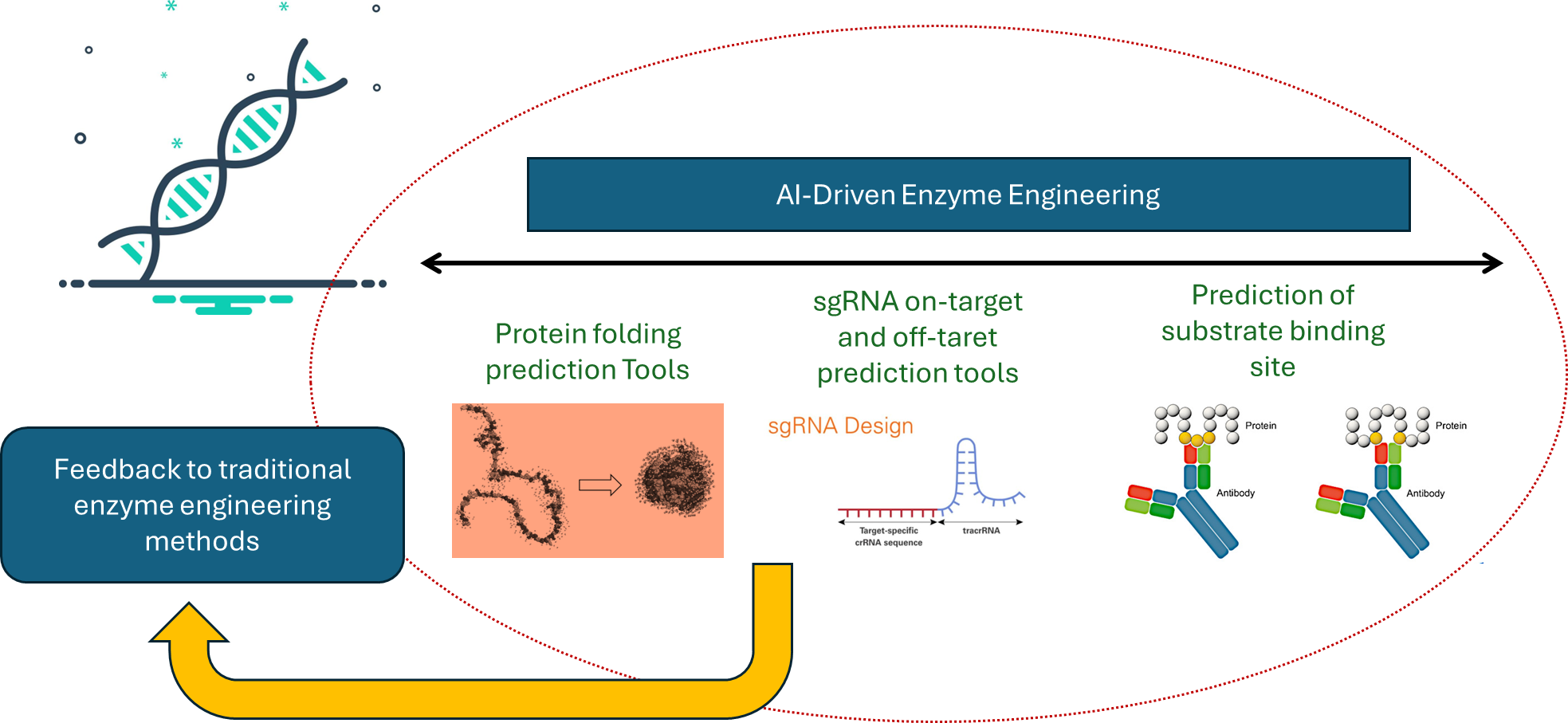
AI-Driven Enzyme Engineering
AI-driven enzyme design methods will be employed, combining sequence-structure databases, generative models, and machine learning algorithms trained on enzyme performance data. Al-assisted novel genome editors and de novo design approaches will be applied to identify beneficial sequence modifications predicted to enhance substrate affinity, catalytic activity, and stability using sgRNA on-target and off-target prediction tools.

