What is the EBIC ECR Challenge?
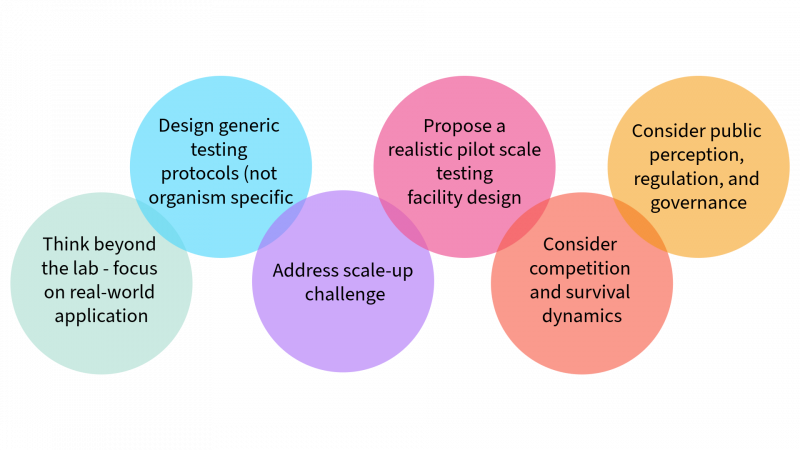
One of the key goals of EBIC is to translate scientific research into practical environmental solutions. This requires addressing two main categories of challenges:
1. Application in real-world environments: accounting for variations in flow and load, background constituents, potential toxins, competition from other organisms, and organism survival.
2. Scaling up for practical use: enabling application at environmentally viable flows and loads, while maintaining acceptable costs, energy use, and greenhouse gas emissions.
Overall, through this challenge, our ECR are expected to design a practical, scalable, safe, and regulatory-aware framework for deploying engineering biology in the environment—working collaboratively and generically, not project-specifically.
Aim
The aim of the challenge is for each group to develop testing protocols and design a testing facility capable of addressing the above challenges. The outcome should be convincing and compelling to potential users. The ultimate objective is to produce a set of protocols and a testing facility for use by the EBIC community and beyond. The “winning” facility will be built at Cranfield’s pilot testing facilities and made available to all EBIC team members.
What must the testing facility be able to do?
• operate under continuous flow;
• be agnostic to the reactor being tested;
• ensure safe operation, with no risk of engineered organisms entering the
environment.
Considerations
Long-term Objectives
For our ECR cohort to develop a national standard protocol for testing environmental engineering biology, that could potentially be adopted by all EBIC partners, regulators, and industry.
Each group will be expected to present its developed testing facility at our 2026 ECR Conference – 16-17 September 2026.

Operational Board
The ECR Challenge has been set out by our Operational Board:

Professor Bruce Jefferson – Cranfield University