
Research at a glance
Paper: Comprehensive approaches in the biodegradation of microplastics: a review of mechanisms, applications, and challenges
Authors: Aman Thakur, Anna N. Khusnutdinova, Alexander F. Yakunin, Peter N. Golyshin, Tony Gutierrez, Mireya Navarro Márquez, Pablo Campo, Vinod Kumar, Frederic Coulon and Roberto Parra-Saldívar.
Published: 3 September 2026, Frontiers in Environmental Science
Research type: Review of existing research into microbial and enzymatic approaches to microplastic degradation.
Focus: Understanding how biological degradation works, how it can be measured, and the engineering challenges involved in scaling it up.
Research Explained
Microplastics are tiny, generally less than 5mm in size, but the challenge they pose is enormous. Microplastics can be found within water, soil and even in the air. Once they are in the environment, removing them is very difficult. Traditional treatment methods can be energy-intensive, complex and, in some cases even generate unwanted by-products.
So, could biology, more specifically microbial breakdown and enzymatic depolymerization, provide a better way forward?
A new review by researchers from Cranfield University, Bangor University and Heriot-Watt University, published in Frontiers in Environmental Science, explores how microorganisms and the enzymes they produce could be used to break down microplastics, as well as what needs to happen before these approaches can be scaled up.
Microorganisms naturally produce enzymes which break down complex materials, at EBIC we like to say they are a bit like tiny biological scissors. Some of these enzymes can also interact with plastics. Plastics are polymers; i.e. made up of many monomers which are held together by bonds. Researchers have investigated enzymes including laccases, peroxidases, cutinases and other polymer-degrading enzymes for their ability to modify or break down different plastics – essentially these enzymes are able to break down the bonds of the plastic polymer into its individual monomers.
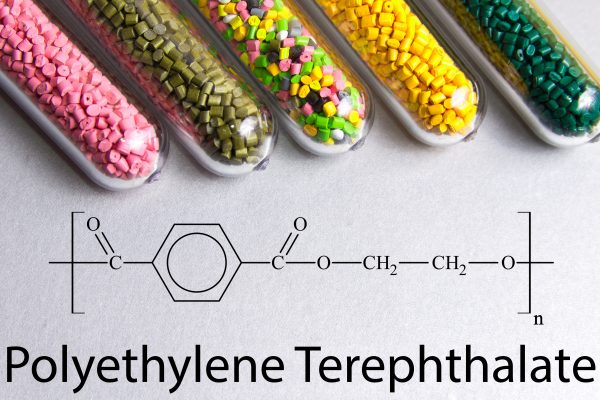
Polyethylene terephthalate (PET), chemical formula. Source Adobe Stock.
However: not all plastics are equally accessible to microbial breakdown. Plastics such as PET contain chemical bonds that can be more susceptible to enzymatic attack. Other common plastics, including polyethylene (PE), polypropylene (PP), polystyrene (PS) and PVC, have highly stable carbon-based structures that are much harder to break down.
One of the review’s key points is that the problem may not be a lack of biological activity. It is getting the microbes and enzymes to the plastic in the first place.
Plastic polymers can be tightly packed and highly crystalline, making it difficult for enzymes to reach the chemical bonds they need to attack; this, the review suggests, is where combining different technologies could make a difference. Physical processes (such as abrasion, extrusion or micronisation) can increase the surface area of plastic; whilst chemical or UV-based treatments can also alter the plastic surface, potentially making it more accessible to microorganisms and enzymes.
The researchers therefore highlight the potential of a combined approach:

This is where engineering biology could have a role to play
Instead of relying solely on naturally occurring microorganisms and enzymes, researchers can investigate how these biological systems work and explore ways to improve their performance. Being able to utilise engineering biology to enhance the capabilities of the enzymes could lead us to develop enzymes which are better equipped to breakdown plastics.
Real world impact?
The review makes clear that significant challenges remain. Many experiments have been carried out under controlled laboratory conditions. Real wastewater and environmental systems are much more complicated, containing mixtures of pollutants and other materials that can interfere with biological processes. We must also take into account the challenge of time – for example some of the biological degradation processes are currently too slow to be economically attractive. When considering costs it is also worth mentioning that the enzymes may need to be used as concentrations which could prove expensive to achieve at scale.
The review also highlights the importance of bridging the gap between promising results in a laboratory and results in the real-world environment with all it’s external influences and changeability. Closing that gap could allow biological approaches to play a role in a more circular system – breaking difficult plastic waste down into useful building materials which can potentially be recovered and reused.
To make these approaches work at a larger scale, researchers need to develop processes that are efficient, affordable and practical. They also need to make sure that any substances produced as plastic breaks down are safe and do not create new environmental problems. Researchers will also need consistent testing methods and a better understanding of the environmental impacts of these processes. These steps will be important if biological recycling is to become a safe and practical way of recovering valuable materials from plastic waste.
Want to learn more?
Watch our EngBioTech Podcast: How can biofilms and bacteria be used to breakdown plastic?
Featuring EBIC researchers Professor Ronan McCarthy & Lyuboslava Harkova, discussing their fascinating work utilising biofilms and bacteria to breakdown plastic – the podcast was released for 2025’s #worldenvironmentday which focused on ending plastic pollution globally – tune in to see how EBIC are doing our part!

