
EBIC contribution at NPL Symposium – Generative Biology: From First Principles to Products (Bushy House)
Last week I attended the NPL symposium “Generative Biology: From First Principles to Products” at Bushy House, contributing to Session 8: Test, Learn and Secure, with excellent contributions from Rennos Frangkoudis (Edinburgh Genome Foundry), Andrea Briones (UK Reference Biofoundry), Jonathan Campbell (MHRA / BP specialist), and Ian Taylor (Cambridge Consultants).
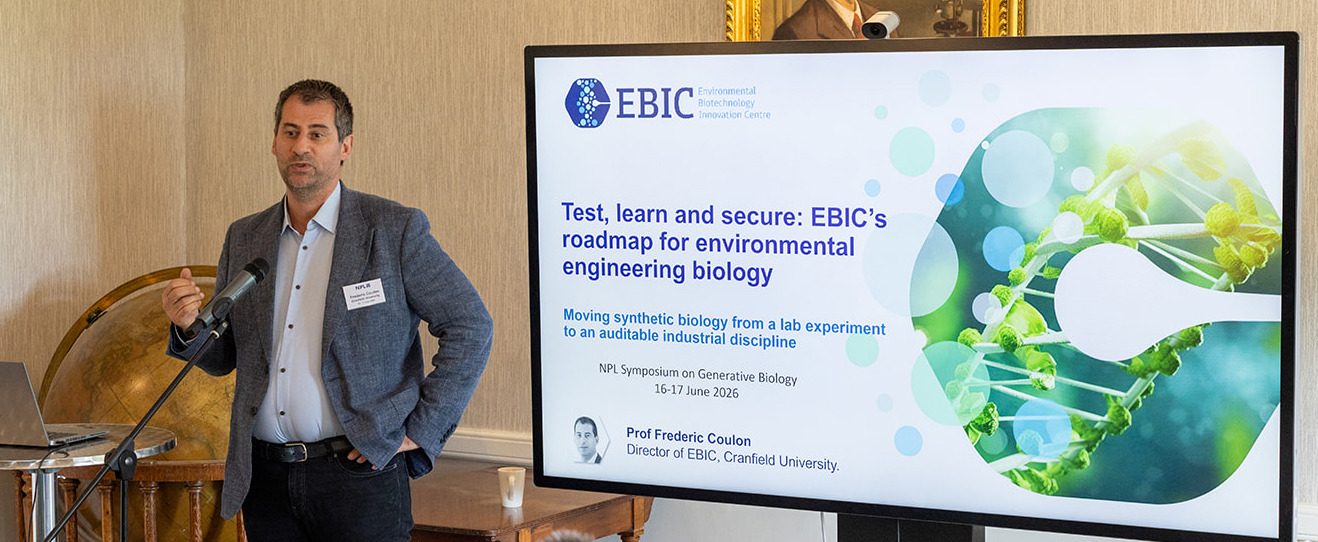
From my perspective as EBIC Director, the session was particularly valuable in framing the emerging convergence between engineering biology, regulatory science, and measurement science as a single translational system rather than separate domains. My contribution focused on a Test–Learn–Secure framework for environmental engineering biology, emphasising the persistent and often underestimated lab-to-field translation gap. In environmental systems, we repeatedly observe that performance metrics derived under controlled laboratory conditions can diverge significantly under real-world constraints, with degradation kinetics and biological activity differing by factors of 4–10 due to heterogeneity, transport limitations, and dynamic environmental loading. This immediately raised a central point for discussion with colleagues across the measurement and standards community: this is not only a biological scale-up issue, but fundamentally a metrology challenge in complex, living systems. That immediately brings us to a question that goes beyond biology itself.
Why this matters?
One of the strongest takeaways for me was just how central measurement science is becoming in this space. For organisations like NPL, NML and LGC, environmental engineering biology is not just another application area, it is one where measurement actually determines whether technologies can scale safely and credibly. A few themes felt particularly important:
- We need traceable and comparable measurements of biological activity in complex matrices like sludge, soil, and wastewater
- We still lack robust ways to express uncertainty when the system itself is biological and variable
- If different labs or platforms cannot produce comparable results, we risk fragmentation of standards and claims
- We need better ways to connect molecular measurements (qPCR, enzymes, omics) with real environmental outcomes like persistence and degradation rates
- And increasingly, even safety functions, like biocontainment or genetic stability, need to be measurable, not just designed
In that sense, “Test” is not just experimental validation, it is fundamentally a metrology problem in living, evolving systems. “Learn” then depends on that foundation. Digital twins, mechanistic models, and predictive tools are only as good as the quality and consistency of the data feeding them. And “Secure” also relies on measurement, because containment, stability, and persistence all need to be verified, not assumed.
Closing reflection
What I took away from Bushy House is that there is now a real convergence happening between engineering biology and measurement science. The conversations were no longer about whether this link is needed, but how quickly we can build it properly. From an EBIC perspective, this reinforces our direction towards what we have been calling environmental probiotics, engineered biological systems designed not only to work, but to be measurable, comparable, and trustworthy across their full lifecycle. It was a useful and timely discussion, and one that clearly signals how important closer collaboration with the UK’s measurement institutes will be as the field moves forward.
Thank you again to Dr Max Ryadnov and colleagues for the invitation.
Author

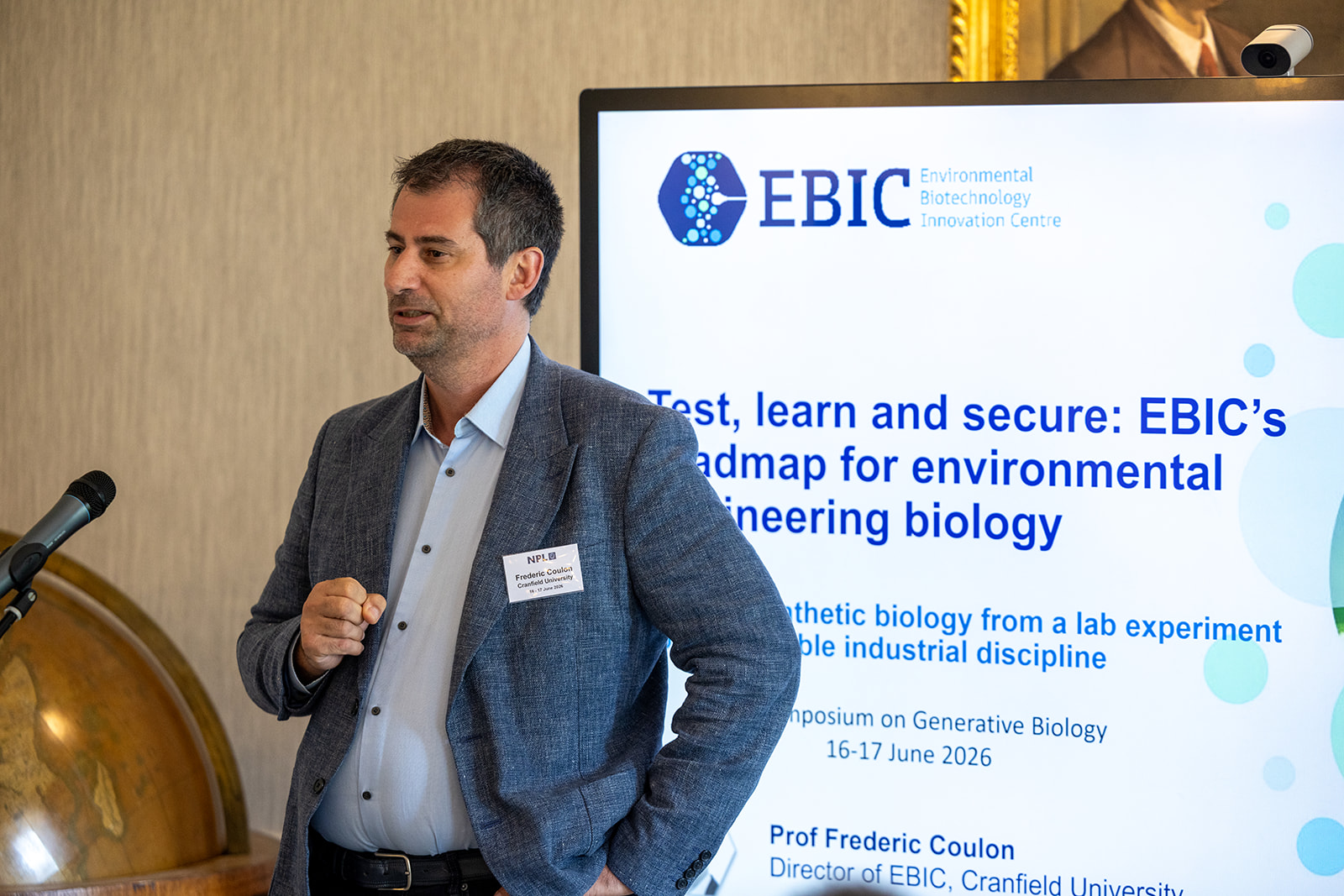
Professor Frederic Coulon, EBIC Director & Professor of Environmental Chemistry and Microbiology at Cranfield University, on the NPL Symposium – Generative Biology: From First Principles to Products (Bushy House).
Learn More

